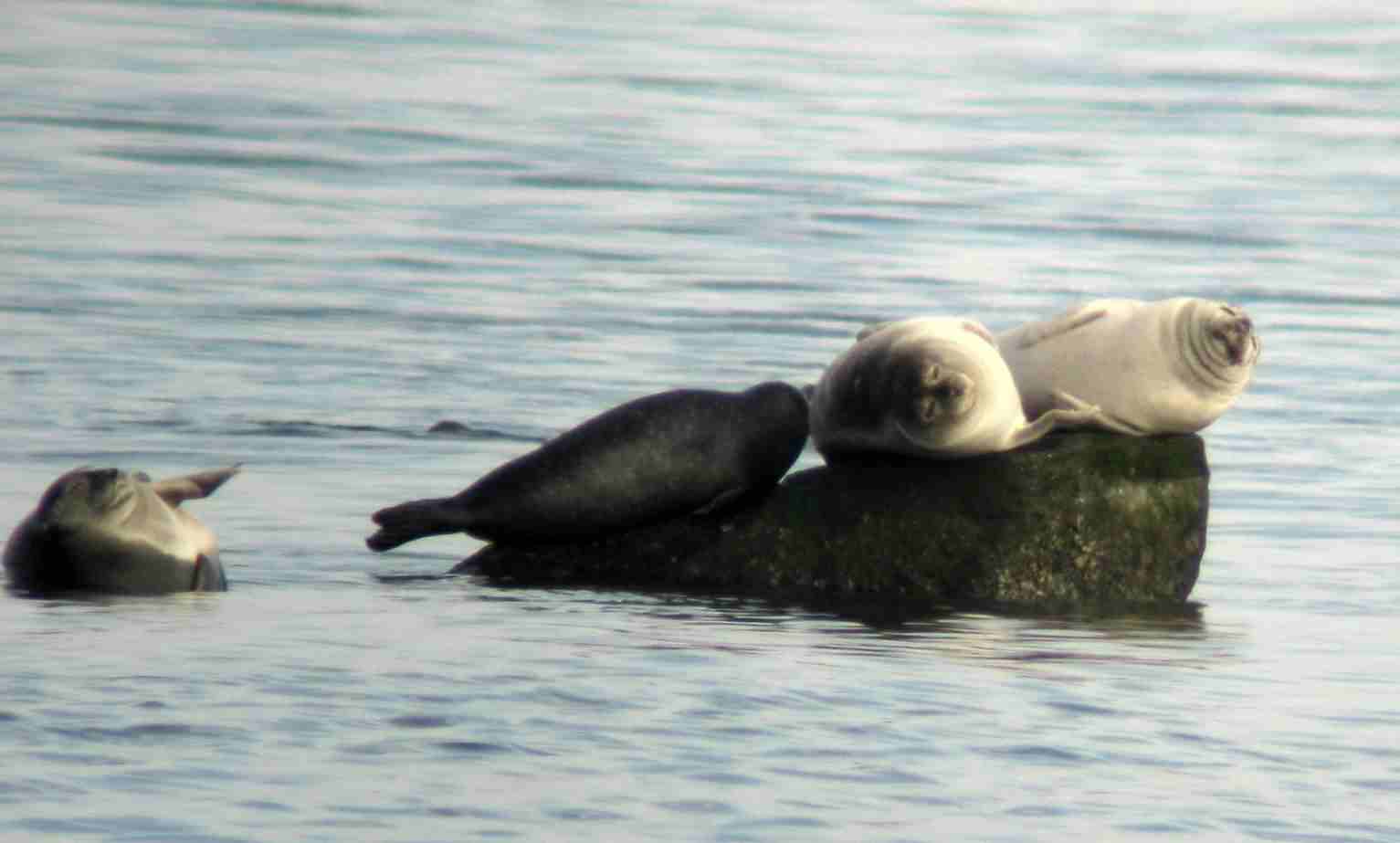
The number of seals at Rome Point varies greatly over the course of each day, as well as from day-to-day. Weather, wind speed and direction, and the tides are the factors which affect the number of seals present at any given time. Unfortunately, any human activity which disturbs the seals can also dictate seal behavior, especially on nice days when the weather is suitable for boating activity. Boats or kayaks will sometimes chase the seals away; when this happens, the seals may not return for many hours. Tips on how to pick a good seal watching day and time of day are listed below; if you follow these guidelines your chances of observing a large number of seals at Rome Point will be greatly enhanced.
· Any
day with calm winds presents a good
seal watching opportunity, especially if
the day has been preceded by several days
of inclement weather or strong winds. The
seals are not bothered by cold and will
haul out on the rocks on most
calm days.
· Strong
north wind (> 15 mph) is not good for
seal sightings; most days when I have
seen no seals it has either been
raining or snowing heavily, or the
wind is blowing hard from the north,
north-northwest, or northeast.
· Strong
wind from an easterly or southerly
direction can adversely affect seal
watching. An east wind can make your seal
watch uncomfortable with a chilly breeze
blowing in your face, while a south wind
generally makes for rough bay conditions
on the outgoing tide.
· Strong
wind from the southwest or west may not
have an adverse effect on the number of
seals present; this is because the
haul-out rocks are somewhat
sheltered by the Rome Point
shoreline. Northwest wind often means
fewer seals will be hauled out, depending
on the wind velocity.
· Fog can sometimes be a problem,
however, the wind is almost always calm on
foggy days. Some of my best seal
observations have taken place as a curtain
of fog burns off, gradually revealing
large numbers of seals on the rocks. The
chances of the seals being disturbed by
watercraft is diminished on foggy days,
making a foggy spring morning a good
opportunity for patient seal observers.
· There
are a number of factors that affect
the daily tide cycle, including wind
speed, wind direction, and the
current phase of the moon.
Seals will usually begin to haul
out from 2 to 4 hours before low tide
at Wickford; on any specific day the
seal's arrival time is correlated to
the weather and tide conditions on
that day. The seals tend to haul out
earlier in the ebb tide when the
extent of the tide change is greatest
(tide especially low) and the wind is
calm. If they are not disturbed, seals
will sometimes remain in the area
resting on the rocks for up to 3 hours
after low tide.
·
The
greatest number of seals are usually
present on the rocks from one hour
preceding low tide until one hour
after low tide. However, on nice
days human disturbance can spoil an
otherwise well-timed seal walk at
low tide. Plan to arrive at the Rome
Point haul-out site 2 to 3 hours
before low tide, especially on warm,
calm Spring weekends when the
seals are most likely to be spooked
by watercraft.
·
Low
tides on temperate, calm weekends
may be challenging for seal
observation due to the possibility
that the seals may be flushed from
the rocks by watercraft. A morning
seal walk is a useful tactic to
increase the probability of seeing
large numbers of seals, whenever the
low tide timing allows for this in
the Spring. The chances of the seals
having been disturbed by watercraft
may also be reduced by arriving on
the beach about 3 hours before low
tide; this tactic will often allow
you to view the seals before boats
or kayaks arrive later in the
haul-out cycle.
·
The
seals are often most active
and interesting when they are
approaching the haul-out rocks for
their rest break. They can
frequently be observed leaping and
splashing; Harbor seals hauling out
on the rocks and settling in to rest
is both amusing and awe-inspiring to
observe. Whenever I can, I time my
seal walks to coincide with the
haul-out arrival time, on the
average about 3 hours before low
tide.
·
The
later into the seal's rest period
that you arrive at the viewing site,
the greater the chance that the
seals have already been scared away
by boats or kayaks. Fortunately,
during weekdays and cold
winter weekends the seals are
usually left alone to bask in peace
for the entire resting cycle.
Weekends on warm, calm spring
days are a challenge for seal
observation. If you want to see
a lot seals on nice days, your best
bet is to arrive early in the
haul-out period.
·
At
Rome Point, the period from 2
hours after low tide to 2 hours
after high tide is not as good for
seal observation. You may see a
few seals, but the haul-out rocks
are mostly submerged and most seals
have moved to open water to feed.
Home
© 2008-2024 Romepointseals.org